URGENT: Support National Health Accounts (NHA) Data Collection (2020/21–2022/23)

ESERA DEVELOPING COST OF SUPPLY FRAMEWORK FOR ELECTRICITY INDUSTRY
July 22, 2025
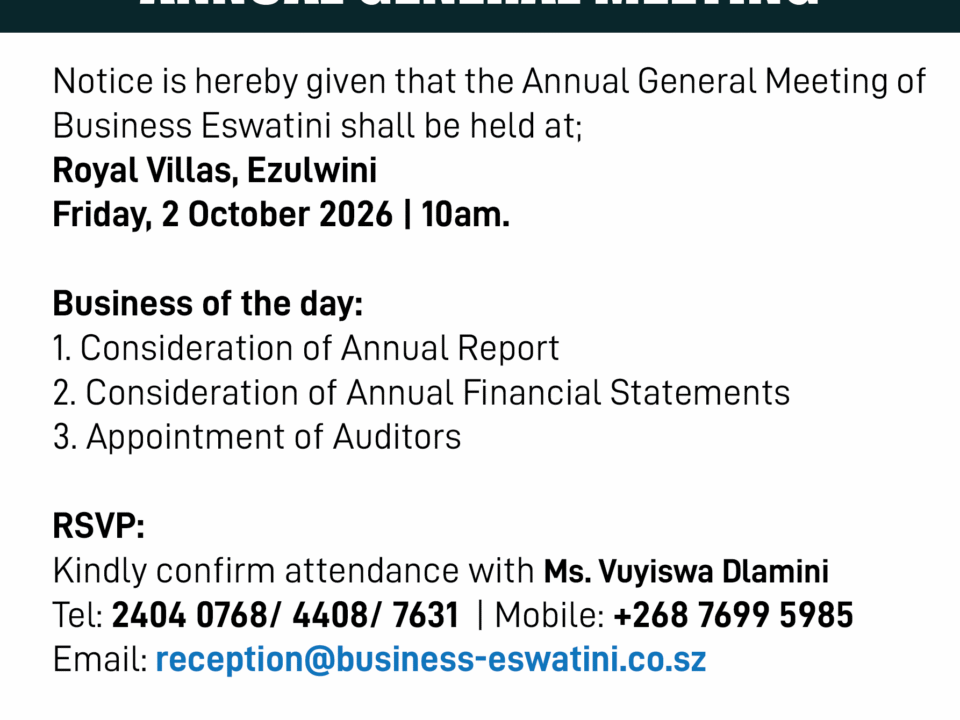
Annual General Meeting (Election Year).
September 16, 2025The Ministry of Health is conducting the National Health Accounts (NHA) exercise for financial years 2020/21, 2021/22, and 2022/23. This initiative is critical for strengthening Eswatini’s health system by:
- Tracking health funding flows and expenditure patterns.
- Informing strategic health financing policies.
- Aligning with WHO global standards for benchmarking.
- Identifying gaps to improve healthcare equity and access.
Your participation as private sector stakeholders is essential to ensure comprehensive, accurate data across all sectors.
Key Actions Requested:
- Engage Proactively: Designated data collectors will contact your institution between 28 July and 29 August 2025 to request health expenditure data.
- Provide Accurate Data: Share details on health-related expenditures (e.g., employee health benefits, CSR health projects, facility operations).
- Support Coordination: Facilitate timely responses to the Ministry’s data collection team.
Why Your Contribution Counts?
- Ensures transparency and accountability in health financing.
- Highlights private-sector impact on national health outcomes.
- Enables targeted interventions for underserved communities.
- Reinforces public-private partnership in nation-building.
Contact for Support Mr. Sifiso Ndlovu
National Health Accounts Coordinator, Ministry of Health
Tel: 7637 8837 | Email: sifisondlovu@ymail.com
We urge every member and affiliated institution to prioritize this request and contribute promptly.
Umhlanga Holiday on 08th September 2025
Please note that His Majesty King Mswati III has officially declared Monday, 8 September 2025, as a public holiday in honour of the Umhlanga (Reed Dance) Ceremony. You are therefore, reminded dear member to make the necessary arrangements regarding public holiday pay and operational planning to ensure compliance.
Mining/Quarry Sector Meeting Reminder
Members of the Mining/Quarry Sector are reminded of the Wage Council Mandate Meeting, which is scheduled for 18th August 2025 at 10:00am. Please note that this is a virtual meeting to be hosted on the ZOOM platform, and sector members will have received the meeting link. Members who have not, are urged to please reach out to the secretariat or directly contact the Client Relationship Manager Ms. Lungile Dube Lungiled@business-eswatini.co.sz
Wages Regulations for Textile and Apparel Industry, Order 2025
The Ministry of Labour and Social Security has officially published the Wages Regulations for the year 2025, for the Textile and Apparel Industry. These Regulations set out the minimum terms and conditions of employment for the sector and serve as a critical reference point for both employers and employees. Members are reminded that these wage determinations represent the floor – not the ceiling – of employment conditions. As such, while many enterprises rely on these instruments for guidance, employers are strongly encouraged to go beyond the minimum standards in pursuit of decent work for all. Members are urged to approach wage policies and determinations with dual focus; ensuring fair and equitable treatment of workers while also safeguarding the sustainability and competitiveness.
Members are encouraged to consult the newly published regulations in detail and align their internal polices and payroll adjustments accordingly.
Executive Summary of the Second Eswatini Economic Update (2025)
The Second Edition of the Eswatini Economic Update by the World Bank outlines a cautiously optimistic outlook for Eswatini’s economy. Growth is projected to reach 5.0% in 2025 and 4.0% in 2026, driven by large-scale investment projects in energy, mining, and infrastructure. However, challenges persist in public finance sustainability, inflation control, and employment creation.
The Eswatini Economic Update (EEU) is structured in two main parts:
- Part 1: The State of the Economy – Reviews economic performance, fiscal policy, and macroeconomic projections.
- Part 2: Harnessing Digital Technologies for the Future – Focuses on Eswatini’s digital transformation strategy as a tool for economic resilience and growth.
- Key Economic Statistics and Projections
| Indicator | 2023 | 2024 (Est) | 2025 (Projected) | 2026 (Projected) |
| Real GDP Growth | 3.4% | 3.2% | 5.0% | 4.0% |
| Inflation Rate | 5.0% | 4.0% | ↑ (within 3–6%) | ↑ (within 3–6%) |
| Fiscal Deficit (% of GDP) | 0.5% | 2.0% | 3.5% | 4.5% |
| Public Debt (% of GDP) | ~40% | 41% | ↑ (to ~43%) | ↑ (to ~44%) |
| Unemployment Rate | – | – | 35.4% (2023) | – |
| Poverty Rate ($3.65/day) | 56.8% (2022) | 54.8% | – | – |
| Current Account Balance | 2.2% (2023) | 1.1% | Deficit | Deficit |
| SACU Revenue (% of GDP) | 14% | 14% | ↓ to 10% | ↓ to 8% |
| Reserves (months of imports) | 2.6 | 2.4 | Target: 4 | – |
- Major Factors Affecting Ease of Doing Business (2025–2026)
Positive Developments
- Projected High Growth: Economic growth of 5.0% in 2025 driven by:
- Large public infrastructure projects.
- Energy sector expansion.
- Reopening of mining operations.
- Digitalization Push:
- “Government in Your Hand” strategy to bring 200 public services online.
- National Payment Switch and e-GP (electronic government procurement).
- SACU Revenue Stabilization Fund:
- Helps mitigate revenue shocks.
- Private Sector Development Focus:
- Implementation of the Companies Bill (online business registry).
- Financial sector reforms to support digital payments.
Key Risks/Challenges
- Volatility in SACU Revenues:
- SACU revenues are expected to decline sharply from 14% of GDP to 8% by 2026, pressuring public finances.
- High Public Wage Bill:
- Stands at 10.9% of GDP (2024); projected to hit 11.3% in 2025.
- Unemployment:
- Extremely high at 35.4% overall, and 56% youth unemployment.
- Weak Public Financial Management:
- Arrears = 2.7% of GDP.
- Budget execution and procurement inefficiencies.
- Currency and External Reserves Risk:
- Reserves are well below the 4-month target (only 2.4 months).
- Inflation Pressures:
- 8% hike in electricity tariffs in 2025 and 7% in 2026.
- Public wage review may add more inflationary pressure.
- Digital Divide:
- Only 3% of the population has fixed broadband.
- 43% of SMEs struggle with digital adoption.
- 90% of person-to-business transactions are still in cash.
- Digital transformation barriers include:
- Regulatory delays.
- Inter-agency coordination failures.
- High cost of broadband.
- Digital skill shortages.
- Policy Recommendations (Most Relevant to Doing Business)
- Fiscal Discipline:
- Contain wage bill below 10% of GDP.
- Digitize tax system for better collection.
- Private Sector Growth:
- Support SMEs and reduce administrative barriers.
- Improve access to credit.
- Develop digital skills in partnership with private sector.
- Digital Reforms:
- Fast-track implementation of National Payment System.
- Build interoperable digital infrastructure (e.g. ID systems, biometric records).
- Public Procurement:
- Use e-GP to enhance SME access to government tenders.
- Sectoral Impact Outlook
- Agriculture
- Contracted by -7.9% in 2023 due to drought, recovered to +1.8% in 2024.
- Projected to grow +4.4% in 2025 (good weather, sugar yields).
- Vulnerabilities: climate shocks, disease outbreaks (e.g., cattle diseases).
- Needs investment in irrigation, climate resilience, and crop diversification.
- Manufacturing
- Rebounded with 7.5% growth in 2024 (exports: sugar, textiles, chemicals).
- Export-led demand to continue in 2025–2026, especially if regional markets expand.
- Dependent on:
- Energy reliability
- Improved logistics and infrastructure
- Policy certainty and reduced arrears
- Mining
- Explosive growth: +66% in 2023 and +23.5% in 2024.
- Fueled by:
- Coal sector rebound
- New licenses from mineral mapping
- Strong contributor to projected GDP growth in 2025–2026.
- Services
- Growth dropped from 6.5% (2023) to 1.8% (2024) post-election boom.
- ICT sector grew 25% in 2024.
- Tourism recovered by 7.8% but remains below pre-COVID levels.
- Digital public services and financial access will unlock further potential.
- Construction
- Contracted -5.5% in 2024 due to delays (e.g. Parliament, ICC).
- Projected sharp rebound in 2025–2026 due to:
- LUSIP II, MNWAP water project
- Roads, power stations, public infrastructure
- Major driver of GDP and employment in near term.
- Financial Sector
- Stable and well-capitalized (25% capital adequacy in 2024).
- NPLs are rising: 7.6% overall (8.8% corporates, 5.8% households).
- Key reforms:
- National Payment System
- e-KYC, Fast Payment Directives
- Essential for improving private sector financing and inclusion.
Opportunity Alert: #TruckHer Campaign
Southern Star Logistics is launching an exciting opportunity for women in logistics the #TruckHer Campaign. Southern Star Logistics is looking to recruit heavy duty licensed women drivers to join their Learner Driver Program – a golden opportunity to kickstart a career in logistics or get upskilled and access more opportunities in the logistics industry.
For more details on requirements and to apply click on the link: https://jobs.eswazi.org/job/learner-driver/ Please feel free to share this opportunity widely.